
Service
Destruction of Expired Cosmetic Products
Classification, ADR transport and documented destruction of discarded cosmetics, including aerosols, perfumery and alcohol-based products.
What does the service include?
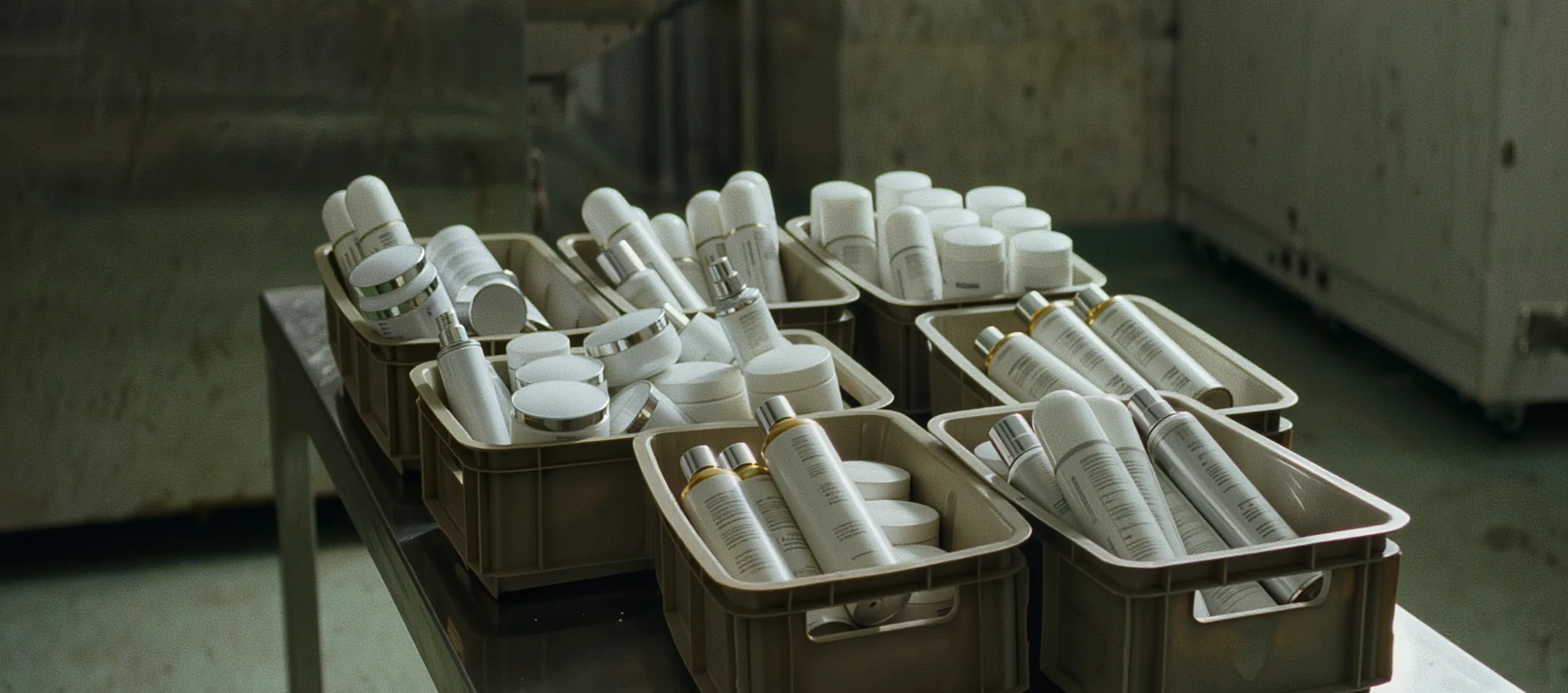
A pallet of cosmetics is almost never a single waste. The cream, the deodorant spray, the perfume and the empty pressurised can carry different codes, a different transport regime and a different final destination. A mistake here is not administrative: it is a class 2 or class 3 load in an unmarked vehicle. That is why the service begins with classification rather than with transport. We establish which items are hazardous waste, split the pallet into streams, and only then plan the run.
- Determination of hazardous properties (HP) from the formulation or the safety data sheet
- Separation of a mixed pallet into streams and assignment of the codes
- ADR transport for aerosols (UN 1950) and alcohol-based products (UN 1266), with an ADR driver and written instructions
- Standard transport for the non-hazardous creams, lotions and shampoos
- Handover to a facility whose document under Article 35(1) of the WMA covers the code in question
- Identification documents for the hazardous streams and consignment documents for the non-hazardous ones
How does the process work?
-
List of items
Send us the items with their trade name and quantity and, if you hold them, the safety data sheets or formulations. The name alone is not enough: the same spray can be hazardous or non-hazardous depending on its propellant.
-
Classification and stream separation
For each item we establish whether it exhibits a hazardous property under Annex 3 to the WMA, most often HP3 (flammability) in alcohol-based products and aerosols. The result is a list of codes, not one code for the whole pallet.
-
Setting the transport regime
We work out whether the quantity of dangerous goods requires the full ADR regime or falls within a relief: limited quantities (LQ) for aerosols, or the exemption under ADR 1.1.3.6. This changes the price considerably, and we tell you up front.
-
Collection and handover
Hazardous and non-hazardous streams travel separately, with the proper marking. Each stream is handed to a facility whose permit covers that specific code.
Documents, legal compliance and codes
As a cosmetic product: until write-off, Regulation (EC) No 1223/2009 applies. The responsible person, meaning the manufacturer, the importer or under certain conditions the distributor, is answerable for safety and, where there is non-compliance, must recall or withdraw the product and notify the Ministry of Health or the relevant Regional Health Inspectorate. The Regulation has applied directly since 11 July 2013 and repealed Section III of Chapter Two of the Health Act together with Ordinance No. 36 of the Ministry of Health. As waste: the WMA and Ordinance No. 2/2014 apply, and ADR applies to the hazardous streams. Transport is carried out under registration document No. 12-РД-2661-00, issued by RIOSV under Article 35(5) of the WMA.
Alcohol-based products and aerosols are the only category among the three we handle where the transport regime is set by the formulation rather than by the type of product. That is why classification is the first step and not an accompanying formality.
Typical codes under Ordinance No. 2/2014
| Code | Description | Type |
|---|---|---|
| 16 03 05* | Organic waste containing hazardous substances (perfumery, eaux de toilette, alcohol-based lotions) | Hazardous |
| 16 03 06 | Organic waste other than that mentioned in 16 03 05 (creams, lotions, masks, shampoos free of hazardous substances) | Non-hazardous |
| 16 05 04* | Gases in pressure containers (including halons) containing hazardous substances: full aerosols with a flammable propellant | Hazardous |
| 16 05 05 | Gases in pressure containers other than those mentioned in 16 05 04 (aerosols with no hazardous content) | Non-hazardous |
| 15 01 10* | Packaging containing residues of, or contaminated by, hazardous substances | Hazardous |
| 15 01 11* | Metallic packaging, including empty containers for pressurised fluids | Hazardous |
| 07 06 99 | Wastes from the manufacture of soaps, detergents and cosmetics not otherwise specified (for manufacturers) | Depends on composition |
* Hazardous waste under Ordinance No. 2/2014
Questions & Answers
How do you decide whether a product is hazardous?
By composition, not by label. We check the concentration of ethanol and other solvents, the type of propellant in aerosols, and pH in depilatory and perming products. The basis is Annex 3 to the WMA, properties HP3, HP4, HP8 and HP14. The conclusion goes into the classification worksheet.
We have no safety data sheets. What do we do?
Cosmetic products do not require a mandatory safety data sheet, so this is a common situation. We work from the formulation, from the product information file under Article 11 of Regulation (EC) No 1223/2009 or, failing that, from testing under Annex 6 to Ordinance No. 2/2014.
Do aerosols need to be emptied before handover?
No. Do not empty or puncture the cans: that is a treatment operation and requires a permit. Full aerosols are carried as class 2 and handed over intact to a facility with the appropriate permit.
If a pallet holds 20 aerosols, does the whole pallet become hazardous?
No, provided the streams are physically separated. That is precisely why we split the pallet before loading. Mixing hazardous with non-hazardous waste is prohibited and turns the entire quantity hazardous, including for pricing purposes.
The product is being withdrawn under Regulation 1223/2009. Does anything change?
Technically no, documentarily yes. On a withdrawal, notifying the Ministry of Health or the Regional Health Inspectorate is your obligation, while our handover documents serve as evidence that the withdrawn quantities were destroyed rather than returned to distribution.
Do you also take manufacturers’ waste, washing water and batch residues?
Yes. Production streams fall under group 07 06 of Ordinance No. 2/2014 rather than 16 03. The classification and the facility are determined separately from those for retail batches.
Request classification and a quote
Send us a list of the items. We come back with a breakdown by stream, the transport regime and a price.